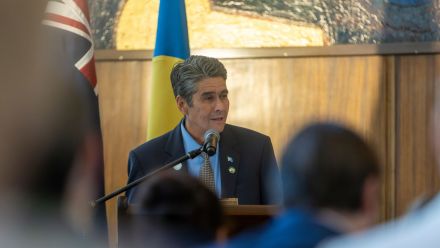
When we finish the archiving, we'll have a single point of entry to the Briscoe-Smith collection as part of the Indigenous Metadata Catalogue on the supercomputer.
The Briscoe-Smith Archive is a nationally significant collection of Indigenous demographic, health and historical research, primarily held by The Australian National University (ANU).
Since 2019, the Indigenous Data Initiative (IDI) has been identifying, preserving, and cataloguing Indigenous-related records across the University, with the Briscoe-Smith Archive forming one of its most important collections. The archive is being incorporated into the Indigenous Metadata Catalogue to ensure preservation, discoverability, and Indigenous Data Sovereignty.
The archive documents decades of ANU research led by Dr Gordon Briscoe and Dr Len Smith on Indigenous population dynamics, health outcomes, and statistical records. It includes demographic datasets, historical census material, research notes, analyses, and supporting documentation.
Following the 1967 referendum and increasing national recognition of the need for reliable Indigenous population data, Dr Briscoe and Dr Smith worked on the Non-Parliamentary Commission of Inquiry into the Future of the Australian Population. Their work highlighted two enduring priorities: ensuring First Nations peoples were accurately represented in official statistics and preserving records that documented their lives and communities.
During this period, Dr Smith undertook efforts to locate and preserve Aboriginal population records held by state and territory agencies. The work revealed significant risks to historical records, including instances where important Indigenous administrative and family-history records had been destroyed. In response, preservation became a central focus of the life's work of both men.
Rescue of the Aboriginal Population Record
One of the Briscoe-Smith Archive's most significant holdings is the Northern Territory Aboriginal Population Record (APR). It contains information relating to 36,848 Aboriginal and Torres Strait Islander people living in the Northern Territory during the 20th century.
In the early 1970s, records associated with the APR were identified as being at risk of loss, and were transferred to ANU for preservation. The digital files remained in storage for decades before being converted into accessible modern formats in 2009. Their preservation ensured the survival of a unique source of information about Indigenous populations, family histories and demographic change.
The APR exemplifies the broader challenge of preserving Indigenous data that is scattered across institutions, stored in obsolete formats or disconnected from its original archival context.
Orphan data and archival consolidation
A major focus of current work by Dr Smith and the IDI team is the identification and recovery of 'orphan data' - records that belong to known datasets but have not yet been linked, catalogued or digitised as being part of them. More than 300 boxes containing over 410,000 pages of Briscoe-Smith material are yet to be systematically incorporated into the archive.
The archive has already been partially indexed using the Heritage Data Management System developed by the University of Melbourne and incorporated into ANU archival systems. Related holdings also exist in other national collecting institutions. Current efforts aim to connect these dispersed materials through common metadata frameworks and discovery tools.
The Indigenous Metadata Catalogue is designed by the IDI team to provide a unified point of access to Indigenous-related material held by ANU. The system links physical archives, digitised records, and associated collections across repositories, enabling researchers and communities easier access to related records.
The Briscoe-Smith Archive is a major collection within the scope of this work. Once fully catalogued, its materials will be searchable across multiple repositories through shared metadata, improving access to historical demographic data, census records, health research and associated documentation.
The long-term objective is a single, integrated catalogue of ANU Indigenous data holdings that supports preservation, discovery, and governance while enabling Traditional Owners and communities to exercise greater control over how Indigenous data is managed and used.
The Briscoe-Smith Archive documents the development of Indigenous demographic and health research in Australia and preserves records that might otherwise have been lost. Its holdings include material relating to historical Aboriginal censuses, population records, health statistics and other foundational datasets that continue to support research and public understanding. Through ongoing digitisation and metadata development by the IDI team, the collection is being transformed into a sustainable research resource that safeguards Indigenous data while making it more accessible and discoverable for future generations.
The process that the IDI team is using to incorporate the Briscoe-Smith Archive is being documented and developed into a methodology for how to treat similar legacy orphan data in future.
Read more about the Indigenous Metadata Catalogue.
For more information, contact the IDI team at idi.fnp@anu.edu.au.
Dr Briscoe died in 2023. Dr Smith admits that cataloguing their shared archive now brings home how much his misses his dear friend and colleague.
“When we finish the archiving, we'll have a single point of entry to the Briscoe-Smith collection as part of the Indigenous Metadata Catalogue on the supercomputer, pointing to the physical records through the ANU Archives Catalogue, and to the digitised records through the ANU Open Research Repository," says Dr Smith.