In its first year, The Australian National University (ANU) had just five female staff. One was chemist Joyce Fildes.
Fildes excelled in a field dominated by men. She endured years of her correspondence being addressed to “Dear Sir” and had a bank book that listed her as “Spinster Chemist”.
Her story is one of many in 80 Years of ANU, a new exhibition from ANU Archives marking 80 years since the University was established.
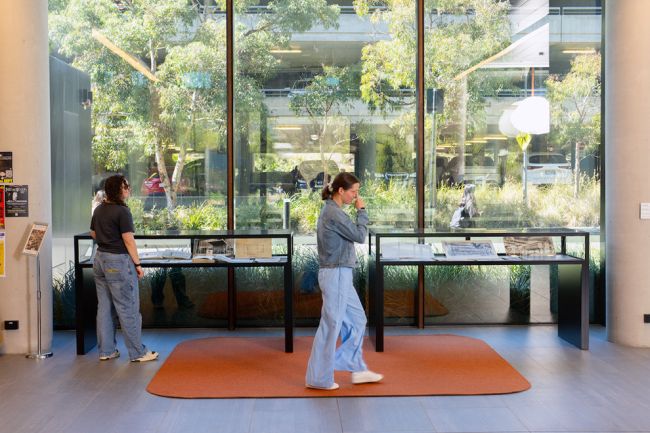
Held in the foyer of the Research School of Social Sciences (RSSS) building, the exhibition was developed by curator and archivist Rachel Armstrong through the lens of themes of the past 80 years – from the ANU founding story to women at the university, Indigenous history and the price of a pie at the Student Union Café.
“The exhibition starts with the reasons why we even have a national university and how the campus developed, but more importantly, the people that have made ANU what it is, focusing on students and some of the most significant research that has come out of the university,” she said.
“I had to be very selective, to fit all that into 10 cases, because as we know there has been no shortage of brilliant minds here over the last 80 years.”
Stopping the brain drain
In 1946, Canberra had around 17,000 residents. Its only tertiary option was Canberra University College, which ran classes after hours at Telopea Park School and offered no postgraduate study or research.
At the time, the Department of Post-War Reconstruction under Dr H C “Nugget” Coombs was trying to stop Australian academics and scientists leaving for jobs overseas. Its answer was a federally funded research university to rival the best in the world.
The Australian National University Act 1946 was passed that August. It made ANU the only Australian university established by an Act of the Commonwealth Parliament. The exhibition includes records from the 1948 Easter Conference, where the first four ANU research schools were decided.
Professor Nicholas Brown, from the ANU School of History, joined the University at the age of 17 and has spent more than 40 years here. He said that history usually presents ANU as a research-only university established in “the halcyon days of post-war reconstruction”, with a sense of national mission that no other Australian university shared.
“ANU was established as a unique institution – that’s undeniable. It was seen as the jewel in the crown of an otherwise impoverished Australian university system at the end of the Second World War,” he said.
“One of the great things about this exhibition is that we get that story, but we also get the internal story, what it was like being here at that time.”
From paddock to campus
The Acton campus sits on the land of the Ngunnawal and Ngambri peoples, who have lived in the region for more than 20,000 years.
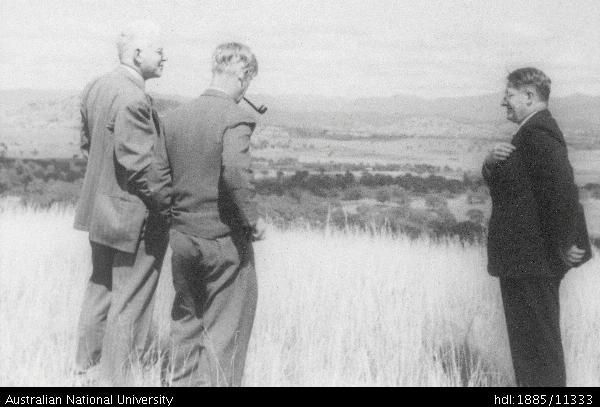
One of the photos in the exhibition shows Mark Oliphant, Keith Hancock and Howard Florey standing in an empty field looking towards the site that would become the home of ANU.
The first administration buildings were three prefabricated huts brought over from RAAF Base Cootamundra in 1949. More temporary buildings soon followed, and John Eccles carried out his Nobel Prize-winning research in one of them.
The first formal intake in 1952 was 23 students. In the 1960s, ANU merged with Canberra University College and began teaching undergraduates for the first time.
Much of the exhibition covers student life, from residential halls and the Student Union to activism, O-Week and Bush Week.
“I really enjoyed learning about how student life has changed at ANU,” Armstrong said.
“For example, a price list in the exhibition from the Student Union Café tells us that in 1970 you could enjoy a pie with sauce for 13 cents, or if you really wanted to splash out, you could order the most expensive meal on the menu – a grilled T-bone steak with an egg, for $1.”
Women in the record
In the early 1960s, male undergraduates outnumbered women three to one. By the mid-1980s, women were in the majority.
Joyce Fildes’ colleague Gwendolyn Woodroofe, a bacteriologist, was credited by Frank Fenner with a major role in the investigations into myxomatosis in the 1950s and 1960s.
“I have dedicated some of the exhibition to women at ANU, given that women are very much underrepresented in our archives, and history in general, and for so many years women’s academic achievements haven’t gained as much attention,” Armstrong said.
The first mention of a woman in an ANU report came in 1951. It was Dorothy Crozier, a Pacific Studies student doing fieldwork in Tonga. In 1964, Hanna Neumann became the first woman to hold a Chair at ANU, and the first female Professor of Mathematics in Australia.
In the mid-1960s, Skaidrite Darius was encouraged to apply for a job with the new ANU IBM Data Processing team, even though the position was advertised for men only. She sat the three-hour test that 35 male applicants had already failed, passed it and became the first woman on the team.
Course instructors assumed she was in the wrong room, and work meetings were often held in bars and hotels that didn’t admit women. When she was expecting her first child, there was no maternity leave, so her colleagues helped her secure five months of unpaid leave. She went on to lead the team, in a career spanning more than 30 years.
“These names may be unfamiliar to you, but they are an important part of our history, as well as many names you will recognise, such as the six Nobel Laureates associated with ANU including Lord Howard Florey and Sir John Eccles,” Armstrong said.
“One thing I think the exhibition makes clear is that as Australia’s national university, ANU has always attracted students and staff who make a difference.”
Worth keeping
Armstrong says the exhibition stops before 2000, because records from the past 25 years mostly haven’t been archived yet. Armstrong hopes someone will tell that part of the story at the centenary in 2046.
“Archives aren't just storage – they’re an important form of memory-keeping for institutions that, like people, can forget where they came from if no one preserves the records,” she said.
“Every photograph, every plan, every object that is in this exhibition survived because someone, at some point, decided it was worth keeping.”
ANU80 is on display in the Research School of Social Sciences (RSSS) Building until the end of 2026. Entry is free.